 Français
  English
  Deutsch
  Português
  Русский
  中国
中国  Español
  日本語
日本語 Gate valves and line blinds are both used to isolate sections of piping systems, but they operate on fundamentally different principles. Gate valves are commonly found in oil and gas, water treatment, and chemical processing, valued for their ability to control liquid or gas flow. Line blinds, like the ONIS Quick Action Line Blind (QLB), provide a more robust and guaranteed isolation. This article will explore the differences in their design, operation, and suitability for various applications.
How a Gate Valve Works
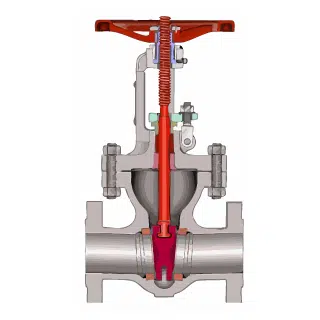
A gate valve uses a movable disc (called a “gate”) to open or close the flow of fluid. When fully open, it offers a nearly unobstructed path with minimal pressure drop. However, gate valves aren’t suitable for throttling or precise flow control. Partially opening a gate valve creates uneven flow, turbulence, and accelerated wear on the disc and sealing surfaces. Gate valves are primarily designed for full open or full closed positions. Typically, they operate at temperatures between 20°C and 60°C and pressures up to around 16 bar. Proper maintenance of packing and internal components is crucial for maintaining sealing, but sealing reliability can decrease over time. According to Health and Safety Executive (HSE) guidelines (HSG-253), gate valves are classified as “proven isolation” devices only under specific conditions, with a recognized risk of leakage over time. Despite these limitations, they remain widely used due to their affordability and versatility.
What Is a Line Blind?
A line blind, such as the ONIS QLB, provides a significantly stronger and more reliable isolation than a gate valve. It’s designed to guarantee a complete physical block between the upstream and downstream sections of the pipeline. The line blind works by separating the pipeline flanges and inserting a solid blinding plate (or spectacle plate) that completely blocks fluid flow. ONIS QLB line blinds can handle extreme temperatures (ranging from -196°C to 650°C) and high pressures (up to 420 bar or higher). Unlike traditional spectacle blinds, the ONIS QLB can be operated in seconds without tools, drastically reducing downtime and improving operational safety. Line blinds are classified as “positive isolation devices,” providing the highest level of safety for maintenance, equipment protection, and process isolation.
Gate Valve vs Line Blind: Four Key Design Differences
1. Body and Construction
Gate valves have a single-piece construction, housing all internal components – the disc, seats, and seals – within the valve body. If internal sealing components fail, fluid can leak from the upstream side to the downstream side, compromising the valve’s isolation. In contrast, a quick action line blind uses three distinct mechanical elements: two separate body sections connected by external linkages and a central blind plate that slides into position. This modular design eliminates reliance on internal seats or seals for isolation.
2. Sealing Component Location
In a gate valve, seats and seals are directly exposed to the fluid flow, constantly subjected to erosion, buildup, and corrosive wear. This exposure leads to seal degradation and loss of tightness over time, especially in processes with slurries or high-velocity flows. A quick action line blind protects these seals, preventing direct contact with the process fluid and minimizing wear.
3. Isolation Integrity and Positive Isolation
Gate valves, even when fully closed, are prone to leakage past the seats and increased leakage as internal components degrade. This is why they are typically classified as “non-proven isolation” unless regularly inspected and used with other devices. Quick action line blinds provide positive isolation by design. When the blind plate is in place, a physical metal barrier separates the upstream and downstream sides, guaranteeing zero leakage, even if the seats or seals fail.
4. Maintenance and Operational Speed
Gate valve maintenance often involves internal component replacement and frequent resealing. Switching a gate valve between open and closed positions can require multiple turns of the handwheel or actuator. Quick action line blinds, like the ONIS QLB, are tool-free and operate in seconds, requiring minimal maintenance thanks to their external positioning of mechanical components and protected seals.
Which Device Should You Choose?
Gate valves and line blinds each have strengths. For regular flow control or non-critical isolation, gate valves offer a practical and economical solution. However, they should never be relied upon for guaranteed isolation in hazardous processes or safety-critical operations. For positive isolation, particularly in systems where safety and leak prevention are paramount, quick action line blinds (like the ONIS QLB) provide a superior alternative, offering faster operation, longer-lasting seals, and guaranteed zero leakage. In practice, gate valves and line blinds are complementary tools, not interchangeable options. Understanding their unique design and operational differences ensures you select the right equipment for each process condition, balancing efficiency, safety, and cost-effectiveness.
External Sources
How a Gate Valves work? (2019): https://youtu.be/C5ZMLWujKGs
Health and Safety Executive’s (HSE): https://www.hse.gov.uk/pubns/books/hsg253.htm
Gate valve a complete guide: https://www.knowpipingfield.com/2023/12/gate-valves-complete-guide.html