 Français
  English
  Deutsch
  Português
  Русский
  中国
中国  Español
  日本語
日本語 To gain a clearer understanding of our environmental footprint and minimize its impact, we conduct our first full‑year carbon audit. In collaboration with ADEME and ABC, Bpifrance is conducting this audit as part of the Décarbon’action initiative. The support for realizing the ONIS 2023 GHG emissions report was provided by iNGENS Solutions. This report details our Greenhouse Gas (GHG) emissions for the fiscal year 2023, showcasing our progress and outlining our future strategies in accordance with our industry decarbonization commitment.
Overview of ONIS 2023 GHG emissions
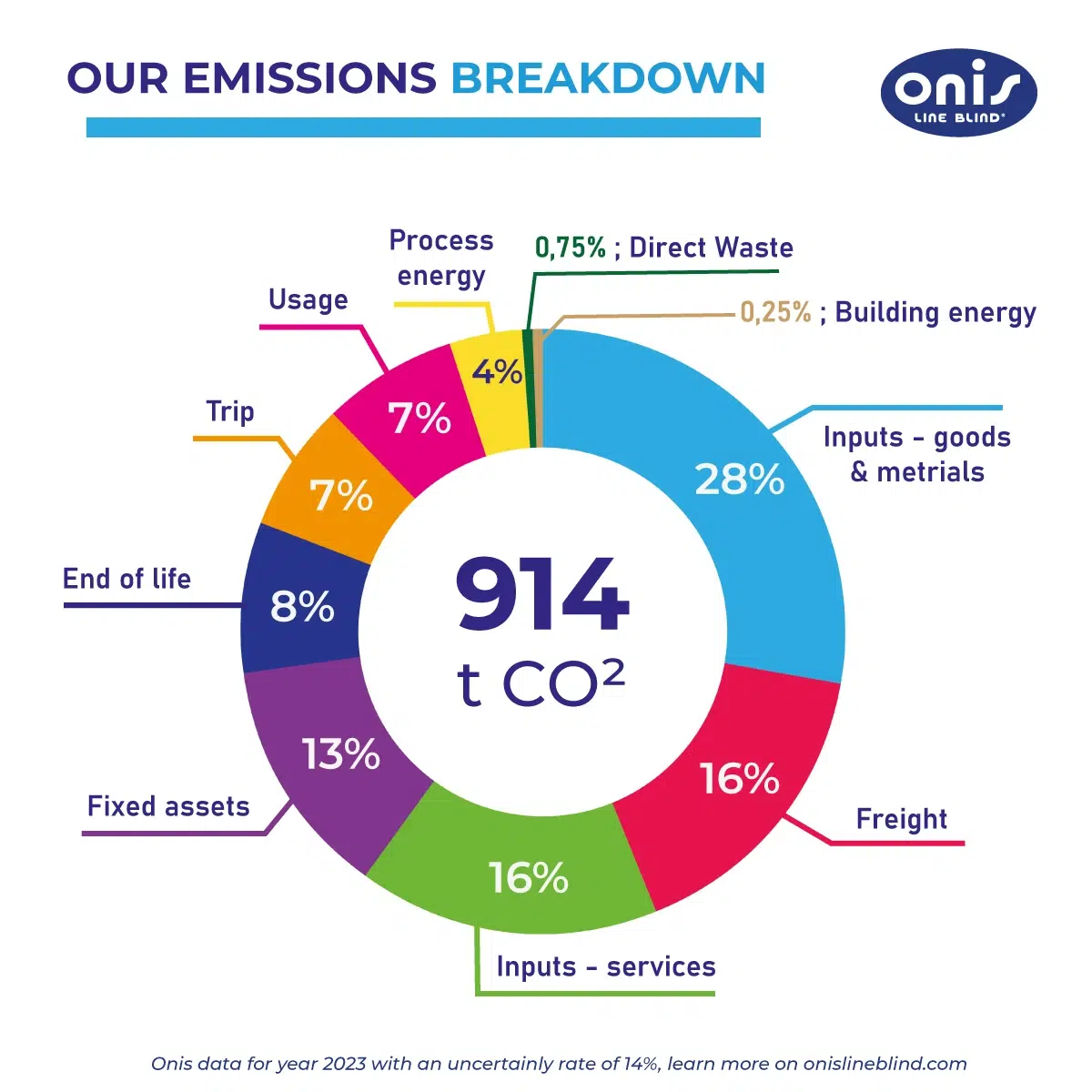
In 2023, our global greenhouse gas emissions reached 914 tons of equivalent CO₂. The main driver of emissions is raw material use, which accounts for 28% of the total. Freight and travel together add another 32%. Other inputs, such as service purchases and end‑of‑life, contribute 24%. The company has a 14% uncertainty rate, indicating a correct data collection and following.
Key Emission Sources
- Inputs, Goods, and Materials (28 %): Conventional steel purchases dominate this category, responsible for 57 % of the input weight and 16 % of overall emissions. Stainless steel follows, making up 38% of the category and 10% of total CO₂e.
- Freight (16 %): Air freight drives this segment, covering 95 % of freight emissions and 15 % of total emissions. Road transport and other modes add the remaining 5%.
- Service Inputs (16%): Holding‑company expenses lead here, representing 41% of the service category and 6% of overall emissions.
Action Plan to Reduce Emissions
ONIS aims to decrease the amount of CO₂ equivalent that is produced for each euro of sales from 119 gCO₂e/€ in 2023 to 105 gCO₂e/€ by 2027. Achieving this target would cut emissions by 98 t CO₂e, a 16% reduction relative to 2023, even as revenue grows. The strategy includes:
- Energy: Optimize building and process energy use.
- Freight: Replace air freight with sea freight where possible, encourage HVO fuel for road transport, and streamline logistics flows.
- Subcontractor: Work with suppliers to lower emission factors for goods and services.
- Ecodesign: Increase recycled material share and reduce product mass.
- Travel: Promote train travel over flights for business trips.
Through these initiatives, ONIS demonstrates a clear path toward carbon neutrality while maintaining its position as an industry leader. The 2023 GHG emissions report provides a transparent baseline for future progress.
If you want to go deeper in our emissions analytics, you can download our summarized report here: Diag DecarbonAction – Communicative summary 2023.