 English
  Deutsch
  Português
  Русский
  中国
中国  Español
  Français
  日本語
日本語 ONIS: Improve Uptime of Your Gas Transmission Process
Natural gas transportation is at the heart of global energy infrastructure, with thousands of billions of cubic meters transported each year. Pipelines, compression stations, and recompression stations are strategic assets whose performance, safety, and reliability are essential. By supporting key players in the sector, ONIS improves their operational efficiency, reduces their environmental impact, and enhances the safety of their operations.
The challenges of positive isolation in gas transportation
Positive isolation is an essential step in ensuring the safety and reliability of maintenance operations on gas transmission networks. It involves physically isolating a section of piping to enable work to be carried out without the risk of leaks or exposure to gas. However, traditional methods like spectacle blinds have several major limitations that affect the availability of facilities, the safety of crews, and environmental performance.
Extended downtime and complex maintenance
Traditional methods, based on the use of spectacle blinds or blind flanges, involve lengthy and laborious operations. Bolts must be removed manually, pipes moved apart, flange surfaces cleaned, and gaskets replaced. These operations require several operators working for several hours, resulting in prolonged downtime and reduced overall equipment availability.
Risks to operator safety
Traditional positive isolation exposes crews to significant risks. Manual handling of piping and prolonged work near potentially pressurized lines increase the probability of accidents. Human errors, such as accidental reconnection or insufficient tightening, can compromise tightness, while exposure to hazardous gases remains a constant concern for personnel safety.
Environmental impact and fugitive emissions
Extended line openings during spectacle blind handling generate gas losses, increasing the carbon footprint and limiting environmental performance, and making compliance with regulations more difficult.
Upgrade Your Gas Transmission Operations With Onis
To address these challenges, ONIS has developed Quick Action Line Blinds that are permanently installed on the lines. These devices transform gas transmission network management by removing the constraints of traditional methods.
Operate in a few seconds instead of hours
Forget the time-consuming part of the traditional methods; our Quick Action Line Blinds are engineered to operate quickly. The operation time is reduced by 95% on average compared to traditional methods.
One-operator solution
Only a single operator can perform the operation without any tools. Easy to operate, operator exposure is minimized, and logistics are simplified.
Minimize Emissions
Improve your overall carbon footprint with a minimized pipe spreading of a few millimeters, just enough to slide the flange while also reducing your fugitive emissions when the line is in operation.
Safe Operation
The system eliminates variability associated with operator judgment. Once closed, the line blind remains locked, eliminating the need for constant monitoring or manual tightening.
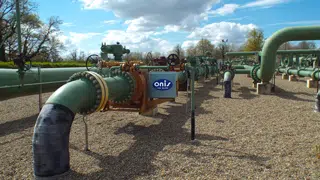
Where do we use ONIS for gas transmission?
Our ONIS Line blinds are versatile and offer a return on investment of 6 to 36 months, depending on the frequency of isolation, diameter, and environment. They are particularly suitable for:
- Main line inlets and outlets for emergency shutdowns or complete unit shutdowns.
- Bypass bridges for isolation and pressure balancing during restart.
- Upstream and downstream of filters, dehydrators, and reboilers, to facilitate maintenance.
- Upstream and downstream of compressors, to reduce downtime and increase availability.
- Vent lines to flares, enabling safe maintenance and reduced emissions.
With ONIS, even flares can be positioned outside the ATEX zone, thereby reducing installation costs.
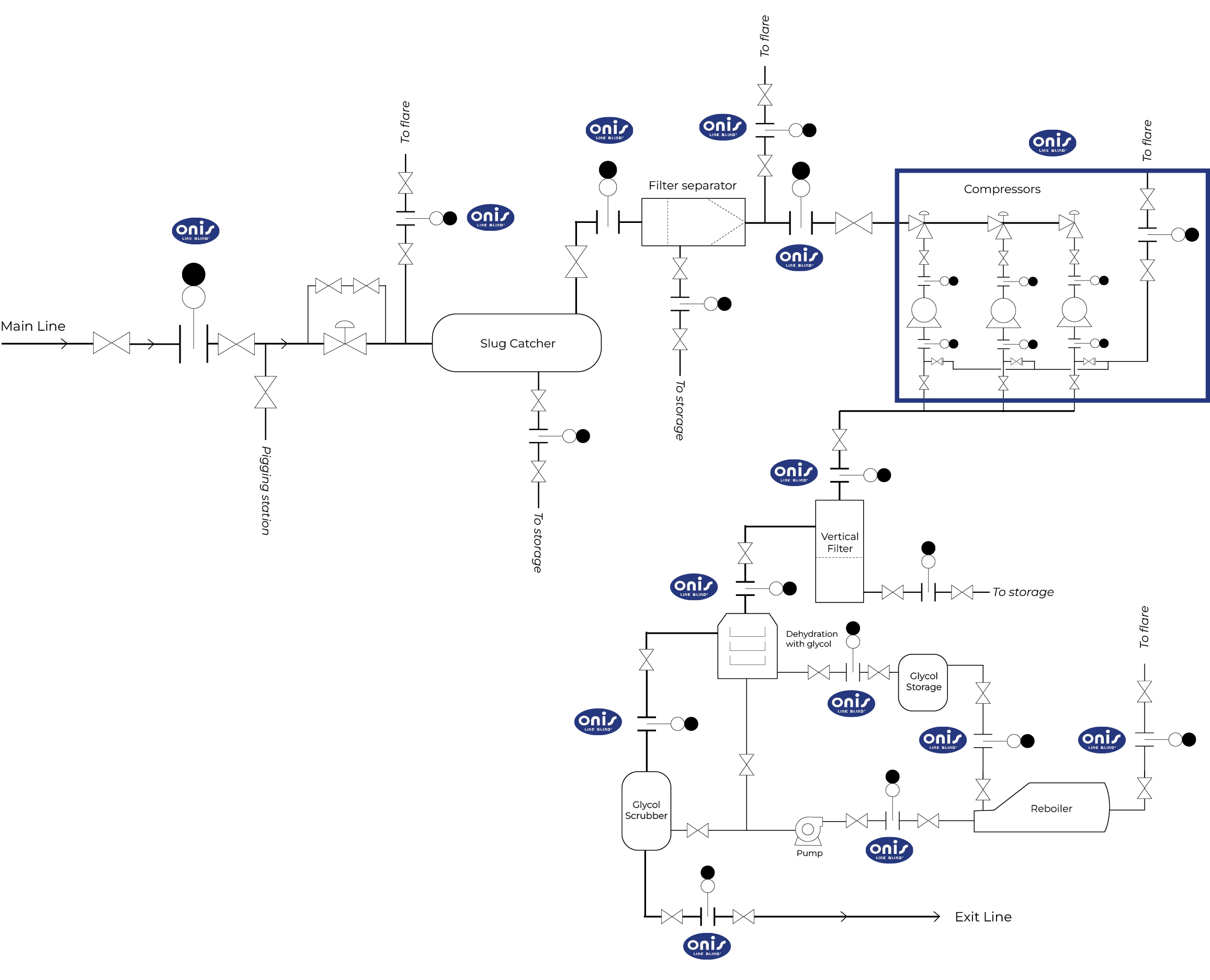
This is a non-exhaustive list of examples of ONIS devices installed at gas transmission networks. Contact us for more details and a more extensive list.
Our products for gas transmission networks
Our philosophy: designing the optimal solution for your specific needs. Our quick-action line blinds and double-block, bleed, and blind solutions are custom configured. Our material selection includes stainless steel, carbon steel, and corrosion-resistant alloys as well as a variety of seal materials—such as FKM, PTFE, and reinforced graphite. Also, we can design specific diameters and pressure classes up to #5500 (420 bars) to meet the most demanding environments.
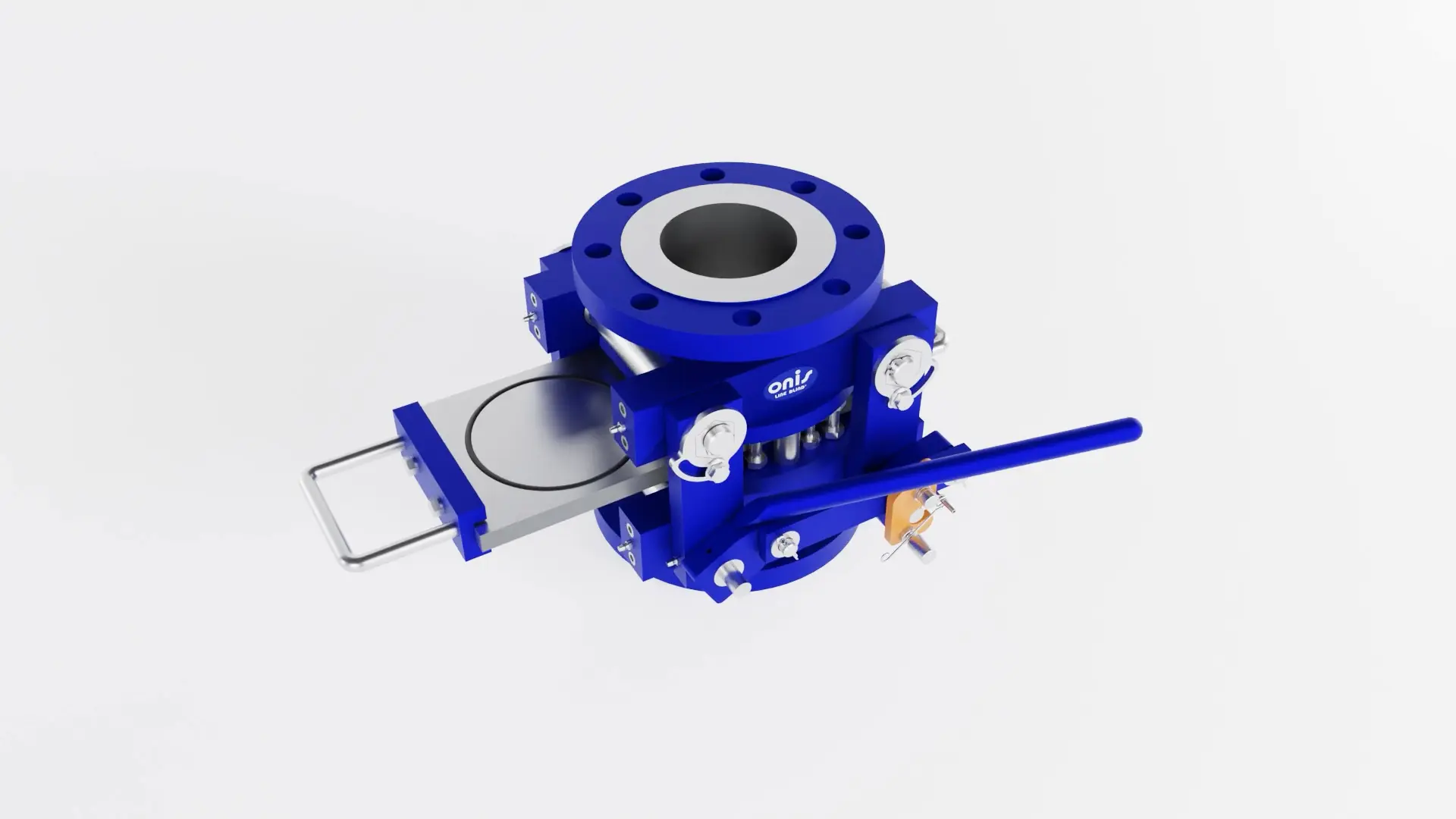
Quick Action Line Blind (QLB)
Our Quick Action Line Blind offers a quick and advanced alternative to traditional spectacle blinds. It provides rapid, tool-free, positive isolation. Its reliable self-locking design ensures the safe containment of hazardous substances while keeping the pipeline connection secure. Learn more.
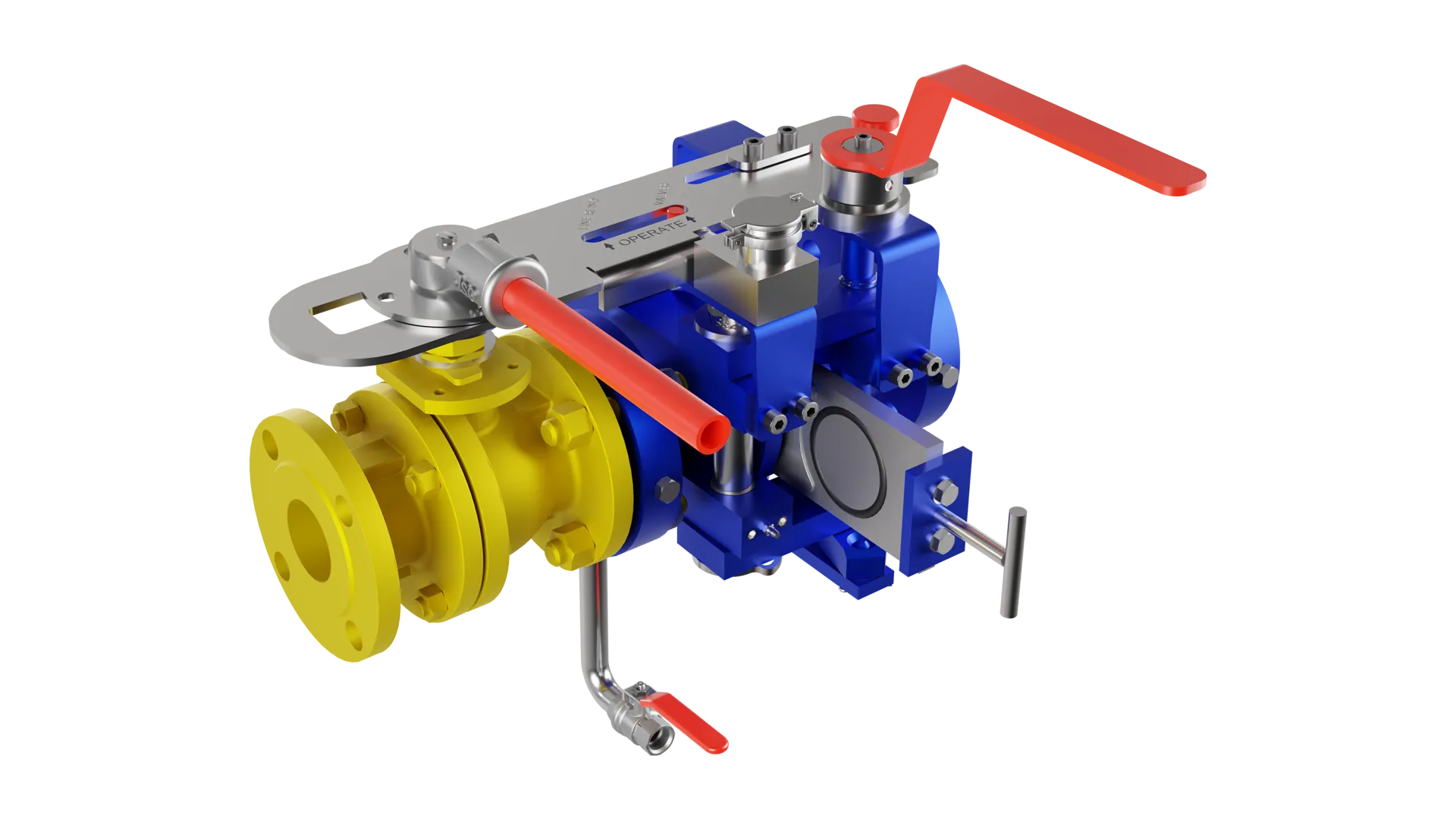
Block Bleed & Blind (D3B)
Designed to eliminate human error, this complete positive isolation device integrates globe valves, a blind, and a safety interlock system to ensure safe and reliable operation. Its compact design also minimizes product waste, making it an ideal choice for applications where space is limited. Learn more.
Contact us today for a personalized consultation and find out how you can optimize your gas network.
Related articles
Steam Cracking Furnace Safety The Benefits of Quick Positive Isolation
Learn how positive isolation devices can improve steam cracking furnace safety, reducing downtime and minimizing risks.
Isolating Pipe Flowing Phenol with Pipe Blind Equipment: A Critical Safety Concern
Learn the safe practices and protocols for isolating pipes flowing phenol. Discover how to protect your assets and people from exposure.