
 English
  Deutsch
  Português
  Русский
  中国
中国  Español
  Français
  日本語
日本語 ONIS DOUBLE BLOCK BLEED & BLIND
D3B - A complete positive isolation solution in one device Contact usOutperform DBB & Reduce human factor – No risk to open the pipe under pressure.
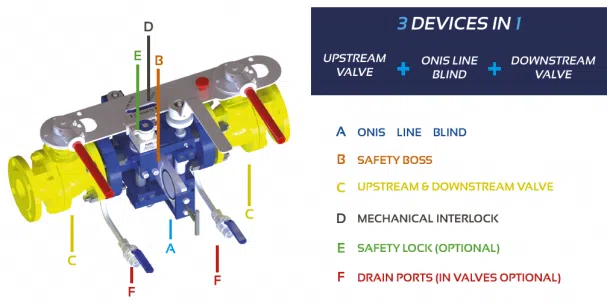
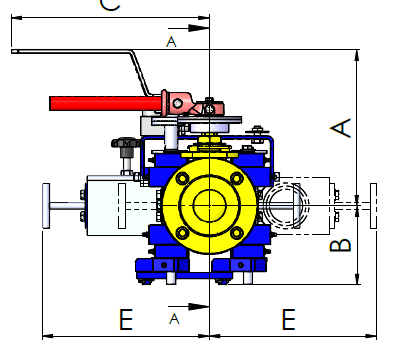
The Onis Double Block Bleed and Blind (D3B) is a complete positive isolation solution in one device, including one upstream valve, one quick action line blind, and one downstream valve. The mechanical safety interlock between the Line Blind and the valves prevents any operation of the Line Blind if the valves remain open, thereby eliminating the risk of operating under pressure. This patented safety device was designed to eliminate operational risks associated with human factors in congested areas and critical applications.

Save time
Safety
No tool

Green design

Pay back
One device, no operational risk
How does it work?
How to operate it ?
The upstream and downstream ball valves are connected to the flanges of the ONIS line blind.
Drain ports are drilled directly into the thickness of the ONIS Line blind’s flanges.
A mechanical interlock prevents the operator from opening the pipe to the atmosphere if the ball valves are not completely closed.
For example : Fluid is passing through the equipment
To isolate the pipe proceed as hereafter :
- Shut off the upstream and downstream valve
- Open the bleeder ports in order to depressurize and drain the dead volume captured between the two valves, which is the smallest possible volume by design.
- Move the interlock mechanism
- Operate the ONIS line blind, blind pipe, and go back to clamp ONIS’ seat position.
- To secure the blinding position by locking it, move the mechanical interlock backward.
Why use a D3B ?
Safety procedures during piping blinding or deblinding operations require a minimum of three steps:
- Shut off the upstream and downstream valves of the blinding or deblinding device.
- Depressurize the pipe by opening the drain port upstream and downstream.
- Drain the liquid from the pipe, if any.
When these 3 steps are done, proceed to the unfastening of the flanges’ fasteners (bolts and nuts).
It is important to note that human error, such as operating the wrong valve or selecting the wrong valve, can lead to pollution and, in some cases, more serious incidents and injuries. This is particularly relevant in situations where a pipe is opened to the atmosphere without first stopping the flow and depressurizing the pipe.
It is sometimes necessary to treat the quantity of lost and wasted product between the valves and the pipe blinding device, as it can have an impact on the environment if not collected.
The ONIS D3B model has been developed to meet the highest standards of safety and environmental protection for piping blinding operations.
Technical specifications
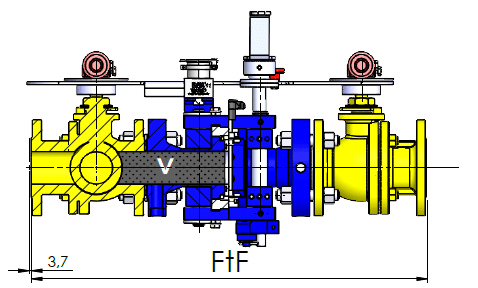
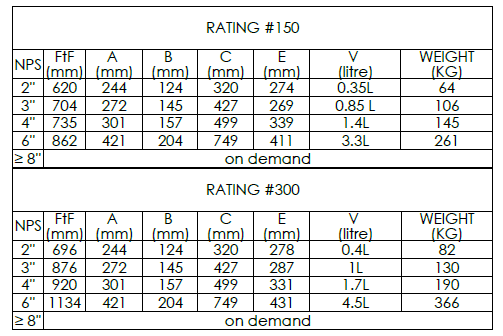
All Double Block Bleed and Blind are designed following these specifications:
- Forged bodies
- Spreading design with no internal mechanism
- Only four gaskets located on the slide gate
- Perfect sealings – 100 % full bore
LINE BLIND SET IN FACTORY: NO APPRECIATION BY OPERATOR
Get more information by contact us
Frequently Asked Questions
How does an ONIS device work?
An ONIS device is a mechanical device that allows a single operator to spread a pipe without the use of tools. This is achieved through the use of eccentric shafts that facilitate the sliding movement of the gate, which can be equipped with various accessories.
What range of products can you supply ?
Our manufacturing capabilities extend from 1’’ to 52’’, with a maximum pressure of 420 bars and a temperature range of -120°C to +650°C. Please refer to the product page for detailed specifications.
Are ONIS devices compatible with all types of media ? Gas, fluid, with particles ?
ONIS devices are compatible with all types of products. Our devices are suitable for use with a range of fluids, gases, and other media, including those with particles or other suspended solids.
Can an ONIS Quick Action Line blind replace a valve?
A mechanized line blind is not a valve. It is a mechanical device that replaces the figure-8 or spectacle blind. A line blind is a real positive isolation device, and a valve is not. When a valve leaks, the leak goes downstream into the pipe. With a line blind, it is impossible because upstream and downstream pipes are physically separated by a steel plate. See the blog article “Positive Isolation Level of Pipelines” for more information.
Related articles
A Wide Range of Custom Design Options for ONIS Equipment
At Onis we create custom products that best fit your requirements, find out about the custom design options available.

Fire Safe design by ONIS
In many critical applications fire incidents can cause major disaster. How the Onis Fire safe design help to reducing risks due to fire.
High performance devices for multiple applications












Develop
Your content goes here. Edit or remove this text inline or in the module Content settings. You can also style every aspect of this content in the module Design settings and even apply custom CSS to this text in the module Advanced settings.
