 English
  Deutsch
  Português
  Русский
  中国
中国  Español
  Français
  日本語
日本語 Pipe isolation is a critical aspect of maintaining safe and efficient operations in various industries, particularly when dealing with potentially hazardous substances or processes. One crucial aspect of maintaining a safe environment is understanding and implementing proper isolation levels. These levels determine the extent to which a section of pipe needs to be isolated from the flow of potentially hazardous substances. Proper isolation levels are essential for preventing accidents during maintenance, repairs, or modifications. The purpose of this blog post is to provide a summary of the HSG-253 guidance document, published by the Health and Safety Executive (HSE).
Factors Influencing Isolation Levels
Isolation levels refer to the measures taken to separate and protect individuals or areas from hazardous substances, processes, or conditions. In the context of piping systems, isolation plays a vital role in controlling the flow of fluids, preventing cross-contamination, and ensuring the safe operation of equipment. Several factors influence the required isolation level for a particular piping system. These include:
- Release Factor: This factor considers the potential consequences of a release. For example, a larger pipe carrying a volatile substance would have a higher release factor than a smaller pipe carrying a less hazardous fluid.
- Location Factor: The location of the piping system is also important. Piping in densely populated areas or near sensitive environments may require higher levels of isolation.
- Substance: The type and properties of the substance flowing through the pipe play a significant role. Highly flammable, corrosive, or toxic substances often require stricter isolation levels than water or air.
The concept of isolation levels is based on a hierarchical system that assesses the potential risk associated with a particular activity or process. This system helps in determining the appropriate level of separation required to mitigate risks effectively.
Types of Isolation Levels
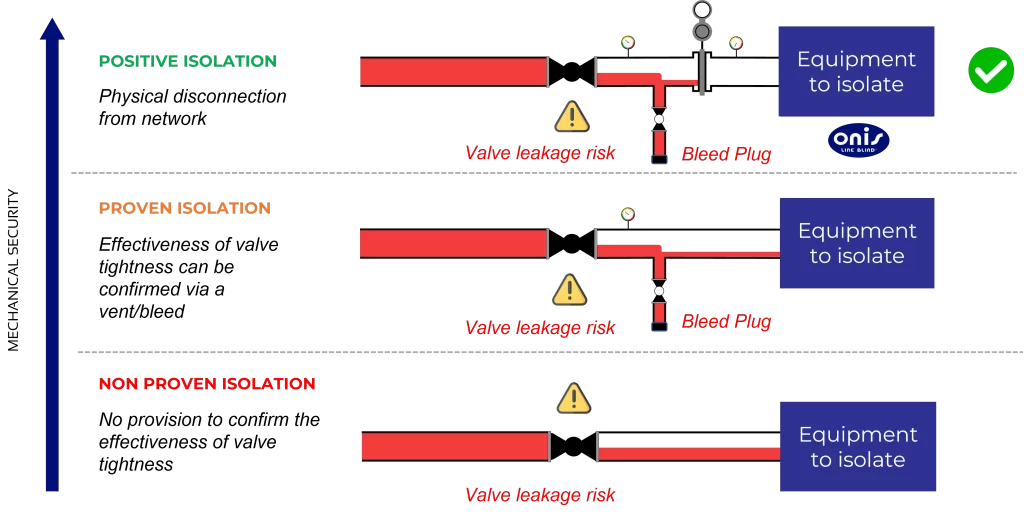
There are generally three types of isolation levels, each offering varying degrees of protection.
Non-proven isolation
The non-proven isolation consists of a valved isolation. There is no way to confirm the effectiveness of the valve closure before breaking into the system. Where possible, double-valve isolation should be used instead of single-valve isolation.
Proven isolation
Proven isolation is another type of valved isolation. Before starting any intrusive work, you can confirm the effectiveness of valve closures by checking vent or bleed points. Within this isolation category, the level of mechanical safety is highest for DBB and lowest for SBB. In general, SBB should not be used with hazardous materials. This level goes beyond simple blockage by incorporating additional measures like pressure monitoring, drain ports, or lockout/tagout procedures.
Positive isolation
Positive isolation entails a complete segregation of the plant or equipment designated for maintenance from other components of the system. This level involves physically blocking the flow of substances through a pipe using a spectacle blind or a Quick Action Line Blind. Furthermore, it is essential that the installation of positive isolation includes valved isolation of an acceptable standard.
Choosing the Right Isolation Level
Selecting the appropriate isolation level is crucial for worker safety and preventing accidents. It’s important to consider all relevant factors, including substance type, release potential, location, and regulatory requirements. Always consult with experienced professionals and follow established procedures when implementing isolation measures.
To assist you in selecting the optimal isolation level for your process, we have created a PDF document, available for download here.
It takes into account two key factors: the release factor and the location factor. The release factor assesses the potential rate of any hazardous substance release, while the location factor evaluates the environmental context and congestion level, which can influence the impact of a release. By combining these factors, an outcome factor is determined, categorizing the isolation standard as Positive Isolation, Proven Isolation, or Non-Proven Isolation.
Remember, prioritizing safety in your piping systems starts with understanding and implementing the right isolation levels.