 English
  Deutsch
  Português
  Русский
  中国
中国  Español
  Français
  日本語
日本語 As an engineer or manager in the process industry, you face daily challenges. You may focus on protecting people, the environment, or developing low-carbon processes. Your work could include designing sustainable units or managing production and maintenance. No matter your role, decarbonization has become a key goal.
Operators often need to isolate pipes by operating valves. This routine work can directly affect carbon emissions. Understanding the link between daily operations and emissions is important.
Operational Risks: The Path to Leaks
Leaks usually stem from equipment failures or human error. To control piping failures, follow health and safety guidelines. The Health & Safety Executive (HSE) offers a matrix in guideline HSG-253 to help you choose the right isolation method. We will not explain the matrix here, but you can read our dedicated article for details.
The main point is that single valves and Double Block and Bleed (DBB) systems, while common, still pose risks. Only positive isolation methods are fully safe and reliable for critical processes.
Limitations of Double Block & Bleed (DBB) for Emissions
DBB is sometimes confused with positive isolation. It uses a bleed system to collect valve leaks and then sends them to a flare, where gases are burned. This setup keeps a vent open and causes ongoing emissions.
Limitations of Traditional Blinding Methods
Spectacle blinds are another common method. They take a lot of time, can let gas leak into the atmosphere, and expose operators to risks. Bleed ports, used to drain leaks, also create emissions. Errors can happen if the blind is misplaced.
Human Factors and Carbon Emissions
Human errors are a leading cause of leaks in hydrocarbon systems. A report from the Norwegian Oil and Gas Association updated in 2018 (link to report accessible in references) shows that 64% of leaks above 0.1 kg/s come from human intervention. This number has stayed stable over time.
Within this 64%, leaks are sorted into four main causes. About 40% come from incorrect blinding or flange fitting, and 31% from wrong valve positions or valve errors. Gasket failures or poor installation make up 17%. Pressurized pipes opened by accident cause 10%, and the rest fall into other categories.
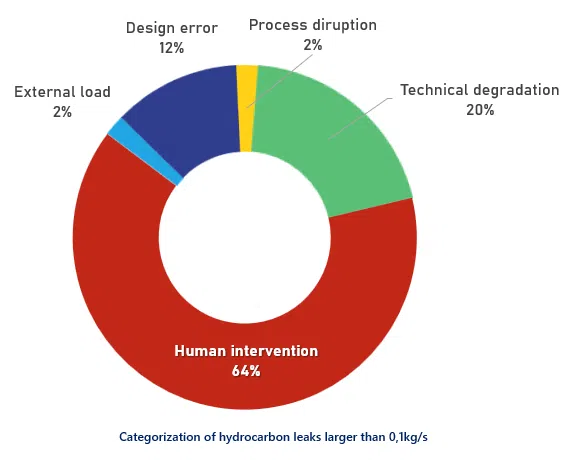
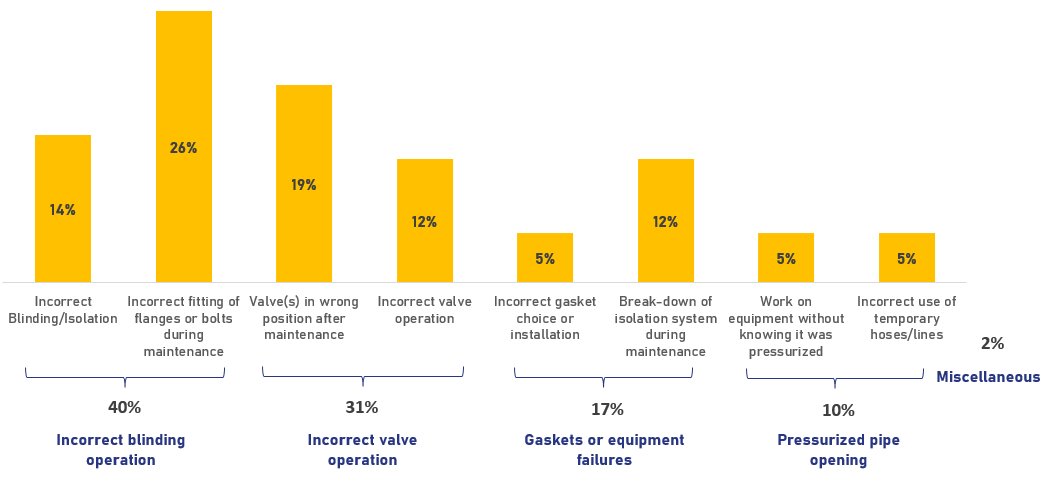
Based on these data, one way to reduce human-related leaks is to use correct valve and blinding operations that don’t depend on operator judgment while avoiding pipe operation under pressure. Let’s look at how to do this next!
How to Reduce Human-Related Leaks
Using the right level of pipe isolation, like positive isolation for important processes, is a good start. But this can lead to mistakes, which might cause leaks. Hopefully, it’s still possible to mitigate this risk; let’s explore three efficient ways to do it.
Develop a Strong Safety Culture
Clear procedures reduce uncertainty. Standard guides and checklists help teams avoid mistakes, especially in complex tasks. A strong safety culture encourages open reporting and learning from both successes and failures.
Use an all-in-one solution like ONIS D3B.
ONIS has over forty years of experience in positive isolation. Our Double Block Bleed & Blind solution is fast and simple. It cuts downtime from hours to minutes. The design reduces dead volume and the risk of mistakes. An interlock system ensures the blind is in the right position. The vented volume is as small as possible, and you can close vents after use to prevent continuous emissions. With D3B, you can cut downtime and emissions and remove up to 90% of human-related leaks.
Regular Training Sessions
Technology helps, but people still play a key role. Mistakes can happen even with robust devices. Ongoing training is essential for safety and performance. Teams must keep their skills current and know how to handle new challenges. Simulation and error management training help staff learn in a safe environment. ONIS offers certified training for safe device operation, which we recommend every two years.
Which solutions achieved zero leaks?
To reach zero leaks, it’s crucial to address human factors. By adopting positive isolation methods like ONIS D3B, developing a strong safety culture, and providing regular training, you can significantly reduce human-related leaks. This multi-faceted approach not only minimizes emissions but also ensures a safer working environment. With commitment and the right solutions, zero leaks is an achievable goal, supporting decarbonization and process sustainability.